





Understanding Industrial Abrasive Tools: A Technical Overview
Industrial abrasive tools are essential components in modern manufacturing, fabrication, and maintenance workflows. Engineered to remove material, shape surfaces, or refine finishes through controlled friction, these tools serve critical functions across metalworking, woodworking, and composite processing. Their performance hinges on three interdependent variables: abrasive grain type (e.g., aluminum oxide, silicon carbide, ceramic), bond system (resin, vitrified, or flexible polymer), and backing material (paper, cloth, fiber, or nylon). Selecting the right abrasive tool requires more than matching a label—it demands alignment with substrate hardness, desired stock removal rate, surface integrity requirements, and operational parameters such as RPM, pressure, and cooling method.
Non-Woven Flap Wheels: Precision Blending and Edge Conditioning
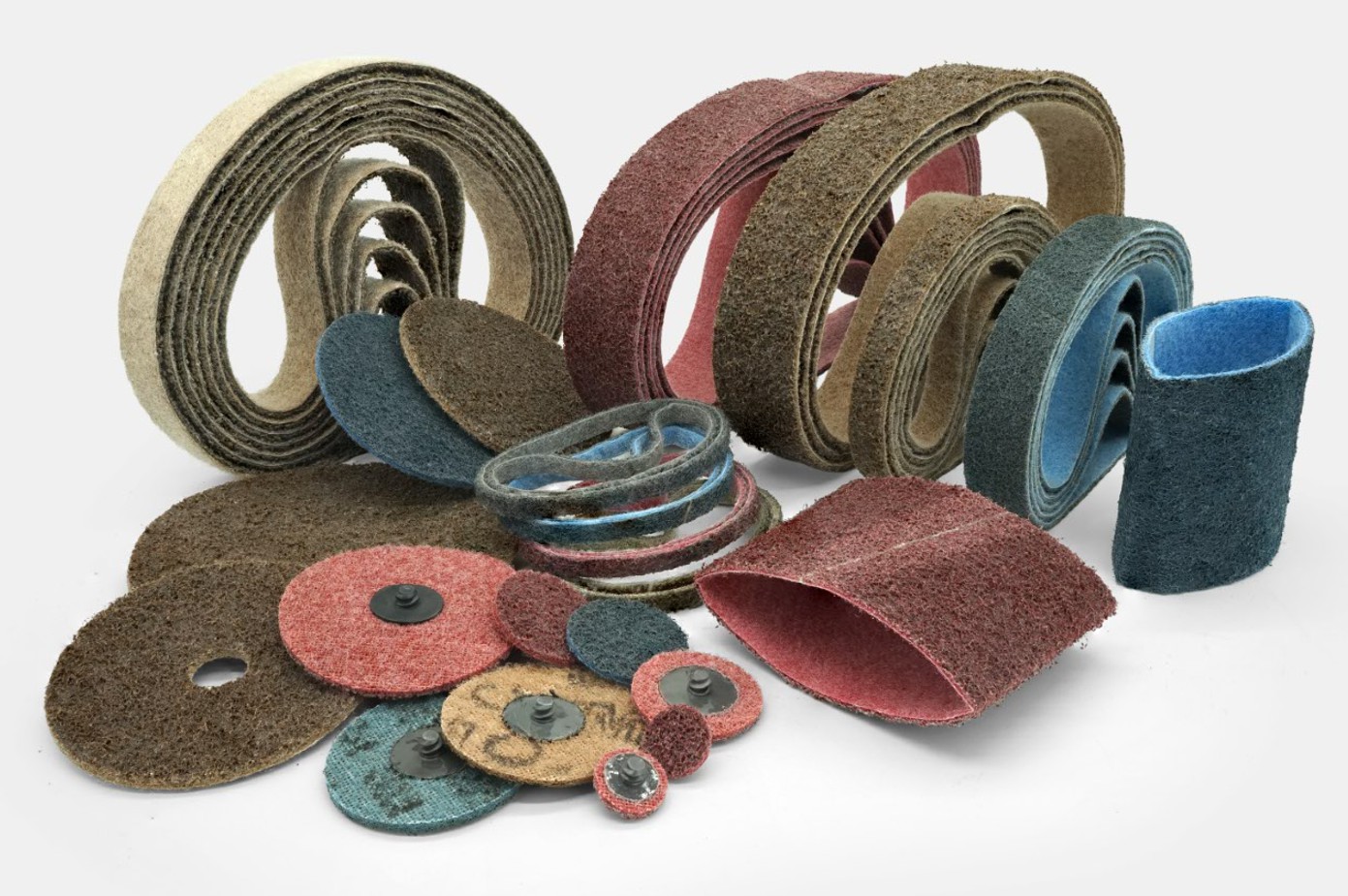
Non-woven flap wheels consist of intertwined synthetic fibers impregnated with fine abrasive grains—typically aluminum oxide or silicon carbide—and bonded with resilient resin. Unlike rigid grinding wheels, their open, porous structure allows heat dissipation and minimizes loading, making them ideal for heat-sensitive alloys and stainless steel. These tools excel in deburring, blending weld seams, radiusing sharp edges, and achieving uniform satin or matte finishes without undercutting. They operate effectively at medium-to-high RPMs (6,000–12,000 rpm) on angle grinders or bench motors and are compatible with both ferrous and non-ferrous metals. For optimal life and finish consistency, maintain light to moderate contact pressure and avoid lateral side-loading.
Strip and Clean Discs: Rapid Coating Removal and Surface Preparation
Strip and clean discs feature aggressive, open-coat abrasive structures mounted on heavy-duty fiber or reinforced polyester backings. Designed for high-speed rotary or orbital sanders, they deliver rapid removal of paint, rust, old sealants, thermal spray coatings, and thick epoxy layers—often removing up to 10× more material per pass than conventional sanding discs. Their segmented or layered construction enhances flexibility and conformability over contoured surfaces while reducing vibration and operator fatigue. Use with dust extraction systems where possible, especially when working with lead-based or hazardous coatings. Compatible with mild steel, cast iron, aluminum, and fiberglass, these discs are not recommended for final finishing due to their coarse cutting action.
Sanding Papers: Versatility Across Grits and Substrates
Sanding papers—available in sheet, roll, and disc formats—form the most widely used category of abrasive tools. Manufactured with coated abrasives on paper, cloth, or film backings, they span grit ranges from coarse (P24–P80) for aggressive shaping to ultra-fine (P1500–P5000) for polishing wood or automotive clear coats. Aluminum oxide dominates general-purpose applications; silicon carbide is preferred for wet-sanding finishes and non-ferrous metals; and ceramic grains offer extended life in high-pressure automated systems. Selection must consider backing weight (A–C for paper; J–X for cloth), adhesive durability, and anti-loading additives. In woodworking, closed-coat papers ensure consistent scratch patterns; in metal finishing, open-coat variants reduce clogging during soft-metal work.
Sanding Belts: High-Efficiency Stock Removal in Continuous Motion
Sanding belts combine high tensile strength backing—usually polyester or cotton-poly blend—with precisely aligned abrasive grains to enable continuous, high-volume material removal. Widely deployed in belt sanders, wide-belt machines, and automated edgebanders, they support aggressive grinding, leveling, and contouring tasks. Belt life and cut rate depend heavily on splice quality (overlap vs. butt), grain orientation (Zirconia-alumina blends improve durability), and tension calibration. For metal applications, use belts with cool-cutting resin bonds and anti-static treatment to prevent spark generation. In woodworking, stearate-coated belts minimize pitch buildup on resinous softwoods. Always verify belt speed compatibility with machine specifications—exceeding rated surface feet per minute (SFPM) risks delamination or catastrophic failure.
Cutting Discs: Precision Separation Under Load
Though often grouped with abrasives, cutting discs represent a specialized subcategory optimized for kerf-controlled separation rather than surface conditioning. Reinforced resin-bonded discs—commonly 1 mm to 3 mm thick—utilize tightly packed aluminum oxide or silicon carbide grains to generate localized heat and mechanical fracture at the cut zone. They are engineered for intermittent, high-RPM use on angle grinders and cutoff saws. Critical safety considerations include maximum operating speed rating, flange diameter compliance, and mandatory use of guard and PPE. Material compatibility varies significantly: thin abrasive discs cut mild steel efficiently but may shatter on hardened tool steels unless specifically formulated with diamond or cubic boron nitride (CBN) segments. Never use cutting discs for grinding or surface blending—doing so compromises structural integrity and increases risk of wheel disintegration.
Selection Strategy: Matching Tool to Application
Effective abrasive tool selection begins with defining the primary objective: Is the goal rapid stock removal, dimensional accuracy, surface texture control, or contaminant elimination? Next, evaluate substrate properties—including hardness (Rockwell or Brinell), thermal sensitivity, and metallurgical composition—as well as geometry constraints (flatness, radius, accessibility). Operational context matters equally: manual vs. robotic deployment, available power, dust collection capability, and required cycle time all influence optimal choice. As a rule of thumb, start with coarser grits for shaping and progress incrementally finer for finishing; match backing flexibility to part contour; and always validate compatibility charts provided by reputable manufacturers before large-scale implementation. Regular tool inspection—checking for glazing, warping, or grain shedding—is integral to maintaining process repeatability and workplace safety.









