





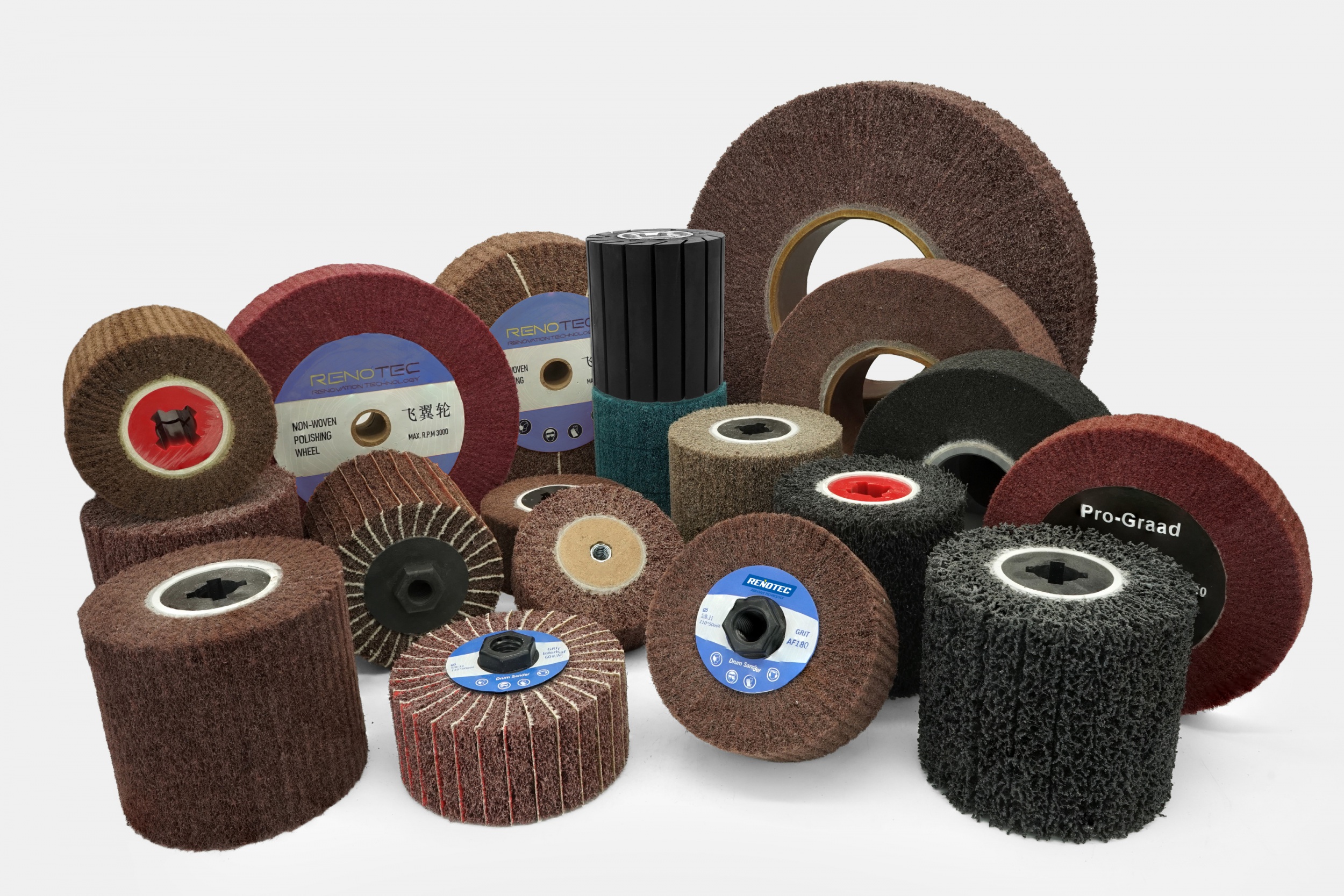
Performance Comparison: Flexibility and Conformability
Non-woven flap wheels and abrasive flap discs differ fundamentally in construction, which directly influences their flexibility and ability to conform to complex geometries. Non-woven flap wheels consist of synthetic fibers (typically nylon or polyester) impregnated with fine abrasive grains—such as aluminum oxide or silicon carbide—and bonded using resilient resin systems. This open, three-dimensional matrix allows the wheel to flex dynamically under pressure, adapting seamlessly to contoured surfaces, tight radii, and recessed areas. In contrast, conventional abrasive flap discs feature rigid, overlapping layers of coated abrasive cloth or paper mounted on a fiber or plastic backing plate. While offering structural integrity for aggressive stock removal, their inherent stiffness limits adaptability on irregular profiles.
Thermal Management and Heat Generation
Heat control is a critical factor in surface conditioning applications—especially when working with heat-sensitive substrates such as stainless steel, aluminum, or thin-gauge metals. Non-woven flap wheels generate significantly less frictional heat due to their self-limiting cutting action and high porosity, which facilitates continuous air circulation and chip ejection. This characteristic minimizes the risk of thermal discoloration, micro-cracking, or metallurgical damage. Abrasive flap discs, by comparison, operate at higher energy densities and retain more heat within the abrasive layer and workpiece interface. Without careful operator technique—including intermittent contact and adequate cooling—these discs can induce localized overheating, compromising material integrity and finish consistency.
Finish Quality and Surface Integrity
When evaluating surface finish quality, non-woven flap wheels excel in producing uniform, matte, or satin finishes with minimal subsurface disturbance. Their fine-grit abrasives and compliant structure enable controlled material removal without gouging or undercutting—making them ideal for final blending, edge radiusing, and aesthetic refinement. Abrasive flap discs deliver faster cut rates and superior stock removal capability, but often leave behind deeper scratch patterns and require secondary finishing steps to achieve comparable smoothness. For applications demanding strict Ra tolerances or optical clarity—such as sanitary surface prep in pharmaceutical or food processing equipment—non-woven flap wheels provide repeatable, low-risk surface conditioning that meets stringent hygienic standards.
Application-Specific Suitability
In weld blending, non-woven flap wheels offer precise contour matching and seamless transition between base metal and weld bead—reducing the need for manual touch-up. Their low-pressure operation preserves weld integrity while achieving uniform texture. For deburring and edge breaking on precision-machined components, these wheels remove sharp edges without altering dimensional accuracy or introducing burr reformation. Regarding rust removal, abrasive flap discs are preferred for heavy-scale corrosion on carbon steel where rapid metal exposure is required; however, non-woven flap wheels perform exceptionally well in light-to-moderate rust removal, especially on galvanized or coated surfaces where substrate preservation is paramount. In sanitary surface prep—where crevice-free, non-porous, and electropolish-ready finishes are mandatory—non-woven flap wheels are widely specified for pre-polish smoothing, passivation support, and post-weld cleaning across stainless-steel fabrications.
Lifespan and Operational Economics
Lifespan depends heavily on application parameters, but general trends emerge: abrasive flap discs exhibit shorter service life under high-load conditions due to rapid abrasive wear and potential backing delamination, particularly when used beyond recommended RPM or pressure limits. Non-woven flap wheels demonstrate longer effective life in medium-duty surface conditioning tasks thanks to their self-sharpening fiber structure and resistance to loading. Moreover, their lower replacement frequency, reduced need for secondary operations, and minimized risk of rework contribute to improved total cost of ownership—particularly in high-mix, low-volume production environments or maintenance-intensive facilities.
Selecting between non-woven flap wheels and abrasive flap discs requires aligning tool properties with process objectives: prioritize non-woven flap wheels for surface conditioning, deburring, light rust removal, and sanitary surface prep where finish fidelity, thermal safety, and geometry adaptability are essential; reserve abrasive flap discs for high-efficiency stock removal, heavy corrosion remediation, and coarse blending where aggressive cutting takes precedence over surface refinement. Understanding these distinctions ensures optimal tool selection, enhanced operator safety, and compliance with industry-specific surface quality requirements.









